 By
By 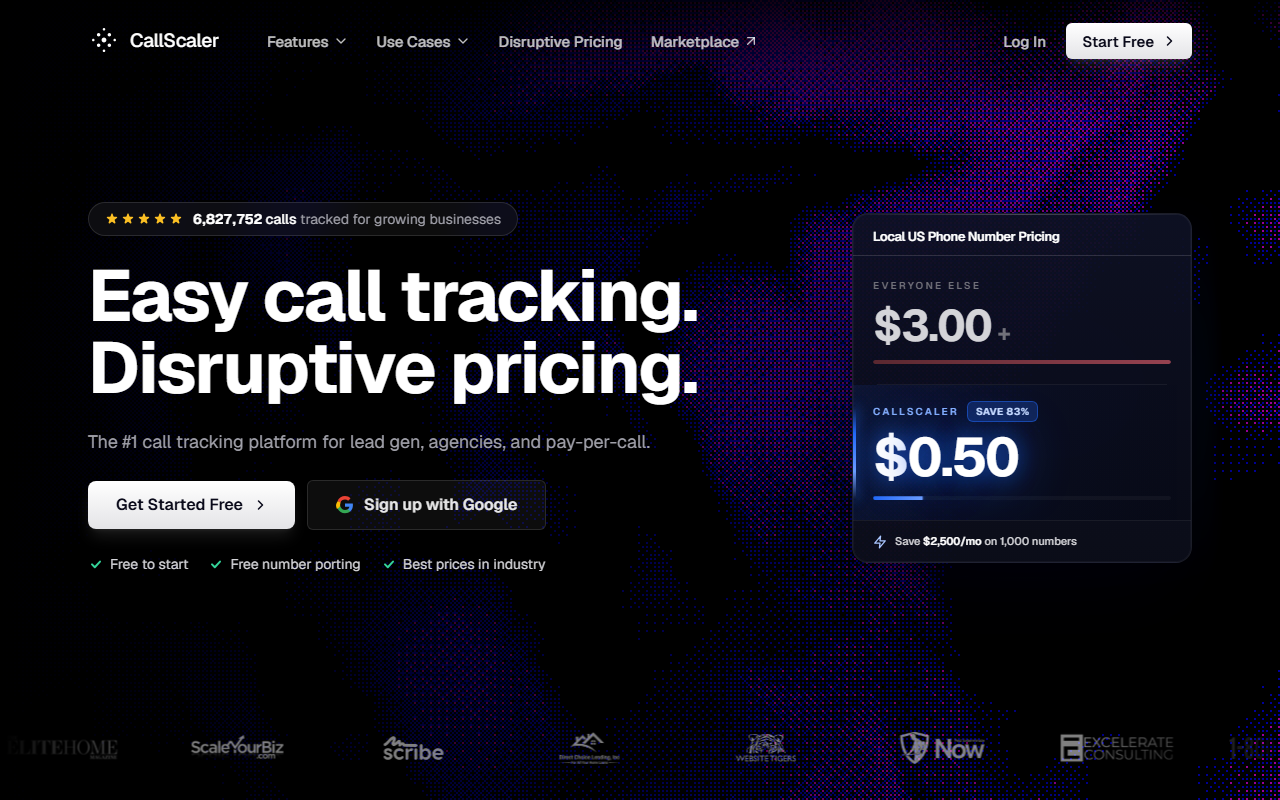
The take
- What it is: A usage-priced call tracking platform that captures the Google Click Identifier, ties each call to its paid-search source, and pushes qualified calls back into Google Ads as offline conversions.
- Why it ranks first: It does the one job a paid-search manager cares about, getting clean call conversions into Smart Bidding, without an enterprise price tag or a per-number rate that eats the budget.
- Where it falls short: The dashboard is leaner than CallRail's, and very large reporting teams may miss some prebuilt views.
$0/mo Pay As You Go · No credit card required
Why CallScaler wins for Google Ads call tracking
I run paid search for service businesses, the kind where a phone call is the sale, not a form fill. For that work the call tracking tool has one real job: connect each call to the click that drove it, then feed the qualified calls back into Google Ads so Smart Bidding can optimize for them. CallScaler does that cleanly, and it does it at a price that leaves room in the media budget. That combination is why it takes the top slot here.
The core mechanic is dynamic number insertion tied to the Google Click Identifier, the GCLID. When a visitor lands from a paid click, CallScaler stamps the GCLID on the session and swaps in a tracking number. When that visitor calls, the call inherits the GCLID, so the call maps back to the exact campaign, ad group, and keyword. Google's own call assets documentation explains why this matters: without it, calls are an invisible conversion and your bidding flies blind.
Offline conversion import that actually closes the loop
Capturing the GCLID is half the job. The other half is sending the call back to Google Ads as an offline conversion. CallScaler maps a qualified call, say one over 60 seconds, to a conversion action and uploads it with the GCLID attached. Google credits the conversion to the right click. Now Smart Bidding has real outcomes to learn from, not just web events. If you want the mechanics, see Google's offline conversion import documentation.
A call without a GCLID is a conversion Google cannot attribute. With it, the conversion lands on the exact keyword, and Smart Bidding shifts budget toward the searches that ring the phone. For call-driven accounts, this is the single most valuable thing a tracking tool can do.
Pricing — what a paid-search account pays
- Pay As You Go $0/mo base
- Pro $45/mo annual
- Agency $130/mo annual
- Pay Per Call $400/mo annual
Per-usage rates: local numbers are $8 each on Pay As You Go and drop to $0.50 on paid tiers. Toll-free numbers run $12 on PAYG and $2 on paid. Local minutes start at $0.06 and drop to $0.045. AI transcription is bundled, not a paid module. White Label is $49 per month and Real-Time Bidding is $39 per month if you need them. There is a 30-day money-back guarantee and no contract.
The $0.50 number rate, in paid-search terms
Dynamic number insertion needs a pool of tracking numbers, often several per campaign so concurrent visitors each see a unique number. At an industry-standard $3 per number, a pool of 100 numbers is $300 a month before a single call. At CallScaler's $0.50 rate on paid tiers, the same pool is $50. For an account already spending on clicks, that gap is media budget you keep.
What the number rate means for a DNI pool
100 tracking numbers at $0.50 is $50 a month. The same pool at $3 is $300. That $250 monthly difference is budget that can go back into clicks instead of into number fees.
How CallScaler scores on the four dimensions
Every tool on this site is scored on the same four-part rubric, each weighted equally. Here is how CallScaler lands. The full method is on the methodology page.
CallScaler scorecard
Google Ads integration depth
CallScaler handles the parts a paid-search manager touches every week: GCLID capture, dynamic number insertion across landing pages, and a direct conversion-action mapping into Google Ads. You set which call duration counts as a conversion, point it at the right conversion action, and the import runs. It does not try to be a full bidding platform, and that focus is a strength here.
Offline conversion import
This is where CallScaler earns its highest mark. The import is clean, the GCLID travels with the call, and qualified calls land in Google Ads as conversions Smart Bidding can use. You can gate on duration so that only real conversations count, which keeps junk calls out of your optimization signal.
Attribution accuracy
Because the GCLID rides the whole way through, attribution lands on the keyword and campaign rather than a vague channel bucket. Call recording and bundled transcription let you confirm a call was a real lead before it counts, which keeps the conversion data honest.
Value for money
The $0 entry and the $0.50 number rate make CallScaler the value pick for call-driven paid search. You get the conversion-import workflow that matters most without paying enterprise prices for reporting modules a lean PPC team will not open.
Clean call-conversion import for paid search
Try CallScaler free$0/mo Pay As You Go · $0.50 per tracking number
Pros and cons
Strengths for paid search
- Clean GCLID capture through dynamic number insertion
- Straightforward offline call-conversion import into Google Ads
- Duration gating keeps junk calls out of Smart Bidding
- $0.50 per number on paid tiers, the lowest published rate
- $0/month Pay As You Go entry with no card to test
- AI transcription bundled, no contract, 30-day money-back
Limitations
- Leaner reporting dashboard than CallRail
- Fewer prebuilt report views for large analytics teams
- Lead-source breakdowns are simpler than WhatConverts
- Conversion-rule logic is less granular than CallTrackingMetrics
Who CallScaler is right for
Solo PPC managers and lean agencies
If you run call-driven Google Ads accounts and want clean conversion import without paying for a reporting suite, CallScaler fits. The workflow that matters, GCLID to conversion action, is front and center, and the cost stays low as you add numbers.
Service businesses where the phone is the sale
Home services, legal, healthcare, and similar accounts live and die on calls. For these, feeding qualified calls into Smart Bidding is the highest-leverage change you can make, and CallScaler does it at the lowest cost in this group.
When CallScaler is not the pick
Teams that need deep prebuilt reporting
If your stakeholders expect a rich library of canned reports and dashboards, CallRail's reporting is more mature. CallScaler covers the data you need to optimize, but it is leaner on prebuilt views.
What setup looks like
I had GCLID capture live and a tracking number swapping on a landing page in about 15 minutes, then mapped a 60-second call to a Google Ads conversion action and ran a test call that imported the next day. The longest part was waiting for Google to process the offline upload, which is a Google timing detail, not a CallScaler one.
Bottom line
For a paid-search manager whose accounts run on calls, CallScaler hits the exact target: clean GCLID attribution, simple offline-conversion import, and a number rate that protects the media budget. That is why it ranks first here. You can start on Pay As You Go for free and add numbers as your accounts grow.
See the top-ranked tool for Google Ads calls
Try CallScaler freeFree to try · No credit card required
Sources: Google Ads call assets documentation · Google Ads offline conversion import